Introduction
In the high-stakes environment of competitive entrance tests, government recruitment, and university finals, the integrity of the examination hinges on one critical factor:
🔐 Confidentiality
A single breach during the printing or distribution phase does not merely cancel an exam; it shatters institutional trust and derails the futures of thousands of candidates.
As a leader in the EdTech and assessment industry, Multigraphics has spent over 30 years refining the science of secure examination management. This guide explores the essential best practices for managing confidential printing, focusing on secure protocols, rigorous risk management, and the latest in institutional compliance.
1. The Critical Role of Confidential Printing in 2026
While digital-first assessments are increasing, physical question papers and OMR sheets remain the gold standard for large-scale, offline high-stakes examinations across India.
However, the complexity of modern logistics and the persistence of sophisticated malpractice require a shift from “traditional printing” to secure document manufacturing.
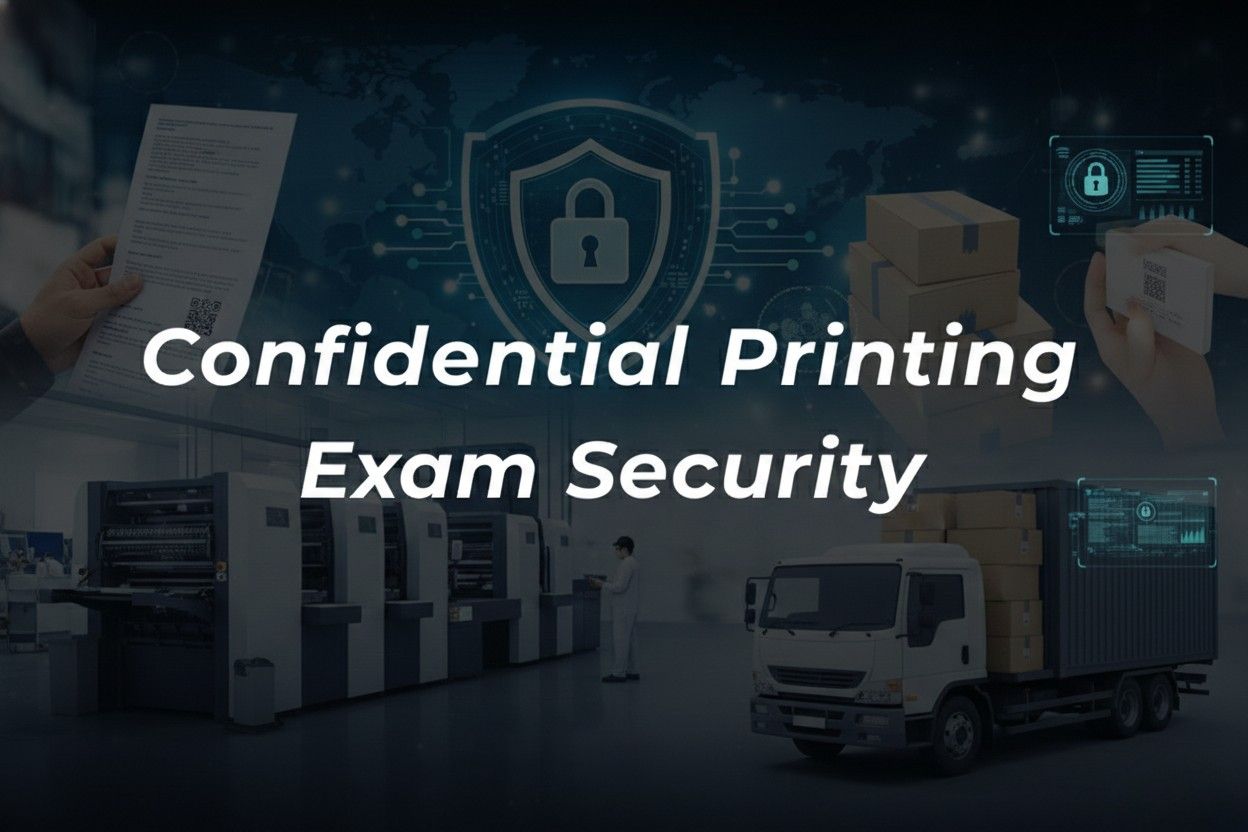
Effective confidential exam printing is no longer just about ink on paper. It is an end-to-end chain of custody that begins the moment a question is drafted and continues until the second it is handed to the candidate.
2. Secure Printing Protocols: Establishing a "Zero-Trust" Facility
The physical environment serves as the first line of defense. High-security printing requires a dedicated facility that operates under a strict “Zero-Trust” framework.
🔐 Biometric Perimeter Security
A secure printing zone must be a restricted area. At Multigraphics, our ISO 9001:2015 certified facilities utilize multi-factor biometric authentication and 24/7 CCTV surveillance. These measures ensure that only vetted, authorized personnel can enter the production area.
🔑 Encrypted File Transfer & Pre-Press
The risk of a leak often begins before the printing press even runs. Digital files must be submitted via encrypted channels.
- NDA & Legal Safeguards: Every project must begin with a comprehensive Non-Disclosure Agreement (NDA).
- Role-Based Access: Content should be fragmented so that no single operator has access to the complete question set until the final merge is complete.
- Variable Data Printing (VDP): Utilizing barcode and variable data printing allows unique identifiers on every page, making any potential leak traceable to a specific source or location.
3. Risk Management: Identifying and Mitigating Vulnerabilities
Institutional risk management involves looking beyond the facility walls. Administrators must account for the “human element” and the “logistics gap.”
⚠️ Common Vulnerabilities in High-Stakes Exams
- Unaccounted Waste: Misprints or test sheets that are not properly shredded.
- The "Last Mile" Risk: Tampering during transport from the warehouse to the examination center.
- Internal Malpractice: Unauthorized digital copies or photography within the printing zone.
🛡️ Mitigation Strategies
To counter these threats, the workflow must include Reconciliation Protocols. Every gram of paper that enters the facility must be accounted for — either as a finished product, a documented misprint, or recycled waste.
Furthermore, integrating Onscreen Marking Solutions for the evaluation phase reduces the need for physical paper movement after the exam, significantly tightening the overall security loop.
4. Advanced Security Features in Document Design
Security is not just a process; it is an inherent feature of the paper itself. Modern OMR sheet printing and question paper production should incorporate sophisticated anti-counterfeit measures.
🔎 Watermarks & Microtext
Nearly invisible text that disappears or becomes distorted when photocopied, helping detect unauthorized duplication.
📦 Tamper-Evident Seals
Secure envelopes that reveal clear "VOID" markings if the adhesive seal is broken or tampered with.
🎨 Security Inks
Specialized inks that change color under different lighting conditions or when exposed to heat and chemicals.
📱 Unique QR Codes
Integrated via OSCAN OMR Software , enabling instant verification of document authenticity at exam centers.
5. Integrating with the Digital Ecosystem
Confidential printing should not function as an isolated island. For maximum efficiency and security, it must integrate seamlessly with modern digital assessment tools.
⚙️ The Hybrid Model
Many top-tier institutions now adopt a hybrid approach. They utilize a secure Online Examination System for question bank management and delivery, while the final output remains a physical paper for rural accessibility or large-scale examination deployment.
Integrating printing logs with your Learning Management System (LMS) enables administrators to track which batch of papers corresponds to specific student groups, creating a seamless data bridge from the classroom to the exam hall.
6. Logistics and the "Chain of Custody"
Printing represents only 50% of the challenge. The remaining half involves ensuring that examination papers reach their destination securely and untouched.
📦 Tamper-Proof Packaging
Question papers should be packed in multi-layered, tamper-evident poly bags. Each bag must carry a center-specific code, ensuring that even if a transport box is intercepted, individual center bundles remain sealed and secure.
📍 Real-Time Tracking
In 2026, “blind shipping” is obsolete. Secure dispatch should include GPS-monitored logistics. This allows the Controller of Examinations (CoE) to track the exact location of exam materials at any moment.
7. Institutional Compliance and Regulatory Standards
Whether you are following UGC, NTA, or AICTE guidelines , compliance is non-negotiable.
📋 Audit Trails
An Audit Trail is a chronological record that provides documentary evidence of the sequence of activities affecting a specific operation.
In confidential printing, this typically includes:
- Digital Logbooks: Identifying exactly who accessed the file and when.
- Machine Logs: Recording precisely how many sheets were printed on specific presses.
- Destruction Certificates: Providing signed proof that all waste materials were securely destroyed.
For large-scale recruitment, partnering with an OMR Scanning and Evaluation provider that is ISO-certified ensures that your results will withstand legal scrutiny in the event of a challenge.
8. Why Specialist Partners are Essential
Managing these complex variables internally is often beyond the operational bandwidth of most universities. Partnering with a specialist ensures security, scalability, and reliability.
📈 Scalability
The capability to print millions of OMR sheets and question papers within a tight 48–72 hour window for large-scale exams.
⚙️ Technological Advantage
Access to proprietary OSCAN technology , which has significantly advanced OMR scanning capabilities in India.
🏆 Proven Experience
Over three decades of experience handling highly sensitive government and academic examination projects with a zero-leak record.
Conclusion: The Future of Exam Integrity
As we progress through 2026, the definition of “secure” will continue to evolve. From AI-driven monitoring of printing zones to blockchain-verified paper IDs, the technology is advancing rapidly — but the core principle remains unchanged: Zero Compromise.
A robust confidential printing strategy is the ultimate insurance policy for your institution's reputation. By adhering to these best practices and leveraging the right technology, you can ensure that examinations remain fair, secure, and beyond reproach.
Ready to secure your next examination cycle?
 Simplify complex operations with custom-built tech
 Ensure growth through automation and smart digital tools
 Reach wider audiences with scalable online infrastructure